
Sancts, in two languages
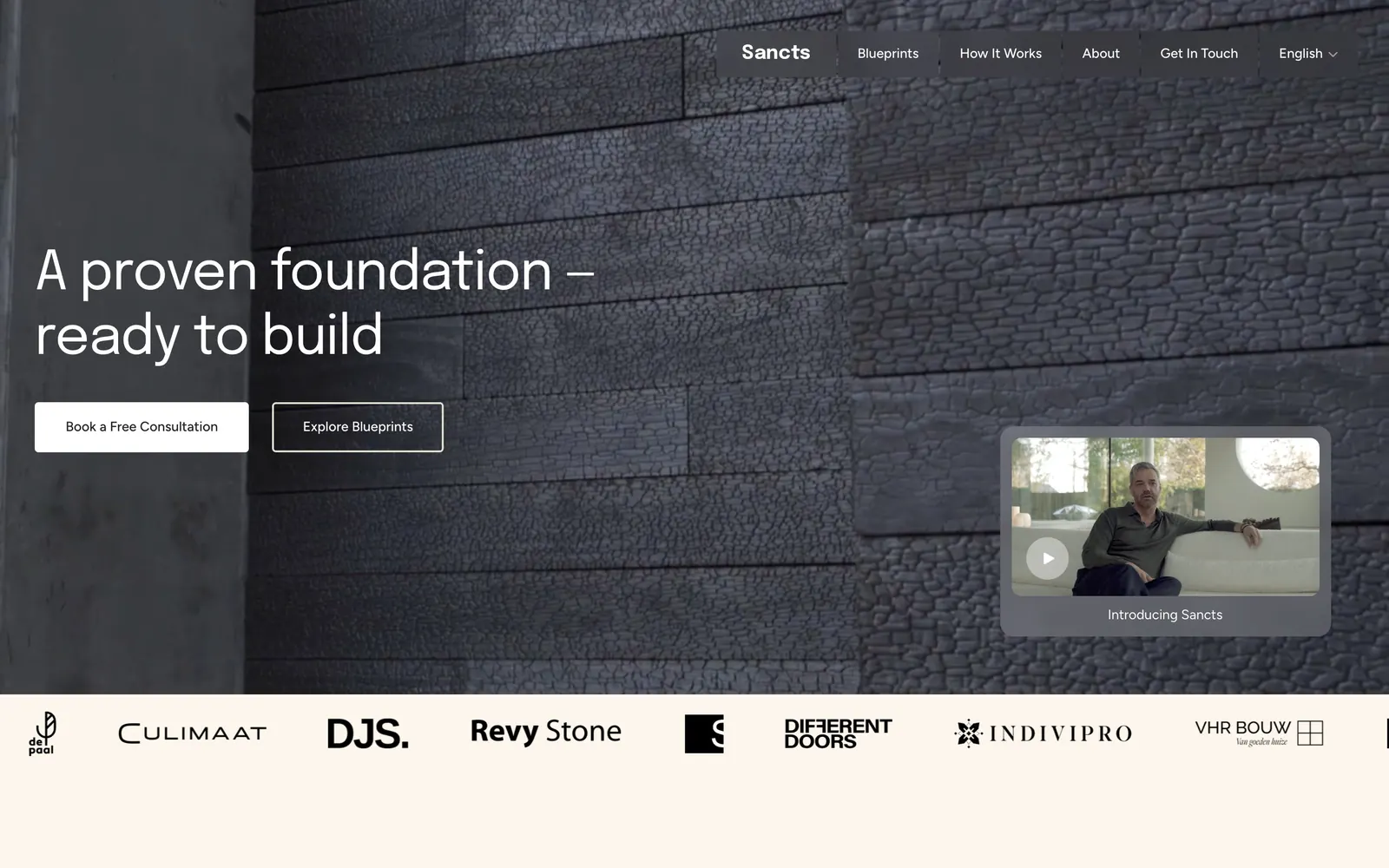
Sancts, in two languages, is a Framer development case: Sancts sells ready-to-build house plans by architect Bob Manders, and Pavlo Zhydkykh built the site in Framer from the client's design, in English and Dutch, 15 pages per language. The site went live in May 2026.
Livesancts.coDoes ChatGPT recommend your website?
Free report in 48 hours · 5 AI engines
- Client
- House plans
- Architect
- Bob Manders
- Work
- Framer development
- Design
- By the client
- Languages
- English, Dutch
- Live since
- May 2026
Key takeaways
- Pavlo Zhydkykh built Sancts in Framer from the client's design, with an English and a Dutch version of every page.
- Each language has a separate sitemap, sitemap_en.xml and sitemap_nl-NL.xml, joined in one sitemap index on sancts.co[4].
- The Sancts pages carry hreflang links for en, nl-NL and x-default, which help Google point each user to the right language version[2].
- Google treats localized pages as duplicates only when the main content stays untranslated[2].
- Framer Localization creates language versions of one site without duplicating the whole project[3].
What is website localization?
Website localization is the adaptation of a website to another language and market: the text, the page paths and the signals that tell search engines which version is which. On Sancts, every English page has a Dutch twin under /nl/, and the pages link the two versions with hreflang tags.
Wikipedia: Website localization

“I treat a second language as more than translated text: paths, hreflang, sitemaps and legal pages each need the Dutch version too.”
Scope
What Pavlo did
- 01
Build in Framer from the client's design
- 02
English and Dutch versions of every page
- 03
Three house plans, each with its own access page
- 04
Privacy, terms and cookie pages in both languages
Two languages
Every page in
English and Dutch
The pairs from the two sitemaps of sancts.co: each English page has its Dutch twin under /nl/, 15 pages per language.
| # | Page | English | Dutch |
|---|---|---|---|
| 01 | Home | / | /nl/ |
| 02 | Earthbound | /earthbound | /nl/earthbound |
| 03 | About | /about | /nl/about |
| 04 | How it works | /how-it-works | /nl/how-it-works |
| 05 | Knokke | /knokke | /nl/knokke |
| 06 | FAQ | /faq | /nl/faq |
| 07 | The Southern | /the-southern | /nl/the-southern |
| 08 | Get access: Earthbound | /get-access-earthbound | /nl/get-access-earthbound |
| 09 | Get access: Knokke | /get-access-knokke | /nl/get-access-knokke |
| 10 | Get access: The Southern | /get-access-the-southern | /nl/get-access-the-southern |
| 11 | Get access: help me choose | /get-access-help-me-choose | /nl/get-access-help-me-choose |
| 12 | Thank you | /thank-you | /nl/thank-you |
| 13 | Privacy | /privacy | /nl/privacy |
| 14 | Terms of use | /terms-of-use | /nl/terms-of-use |
| 15 | Cookies policy | /cookies-policy | /nl/cookies-policy |
Checklist
7 checks for a website in two languages
The checks a two-language site has to pass, each one visible on the live Sancts pages. The list works for any pair of languages.
1. One URL per language
Each version needs a separate address. On Sancts the English page sits at /about and the Dutch one at /nl/about.
2. hreflang on every page
Google asks each language version to list every version, the page's own included. Sancts pages list en, nl-NL and x-default.
3. A fallback for other languages
The x-default link tells Google which page to show visitors whose language has no version. On Sancts that is the English page.
4. Translate the main content
Google treats localized pages as duplicates when only the menu and footer are translated. The body text needs the second language too.
5. A sitemap per language
Separate sitemaps make each version easy to submit and check. Sancts has sitemap_en.xml and sitemap_nl-NL.xml, 15 pages each.
6. The page language in the HTML
The lang attribute tells screen readers which language to read in, and Sancts pages declare en or nl-NL. Google does not use the lang attribute to detect language.
7. Legal pages in both languages
Privacy, terms and cookie pages need the second language as much as the home page. Sancts has all three in English and Dutch.
Fit check
Is a Framer build from your design
right for you?
A good fit if
- Your design is finished in Figma and needs a faithful build in Framer.
- The site has to work in two languages, with a URL, hreflang and a sitemap per language.
- Your team wants both languages in one Framer project, not two sites to keep in sync.
- Every product needs a page and a request page, like the three Sancts house plans with an access page each.
Not the right fit if
- The design is not done yet: then a design and build project fits better, as on NimbleStax.
- Nobody on your side can check the second language before launch.
- The site must stay on WordPress or Webflow: Pavlo builds only on Framer and Astro + Sanity.
Compared
Two sites, or one site with two locales
A second language can live in a second site or in the same Framer project. Sancts keeps both languages on one domain, with the Dutch pages under /nl/.
| Criterion | A separate site per language | One Framer project, two locales |
|---|---|---|
| Projects to keep up | One per language | One, with a locale per language |
| Design changes | Made in every site | Made once, shared by both languages |
| Untranslated text | Missing, or copied over by hand | Falls back to the default language until translated |
| URLs | Separate domains or folders, set up per site | A folder per locale, such as /nl/ on Sancts |
| hreflang links | Added and kept in sync by hand | On the Sancts pages: en, nl-NL and x-default |
How it works
How a two-language
Framer build runs
The order Pavlo follows on a build from a client design in two languages, the kind of project Sancts was. A multi-page site takes 2 to 4 weeks.
| # | Step | When | What happens | You get |
|---|---|---|---|---|
| 01 | Call and fixed price | Week 1 | A call about the design, the pages and the languages. | A fixed price and timeline in writing |
| 02 | Design check | Week 1 | The Figma file read page by page for missing phone layouts and states. | A list of open questions before the build |
| 03 | Build in Framer | Weeks 1-3 | Pages, components and CMS built from the design, desktop to phone. | A working site on a preview link |
| 04 | Second language | Week 3 | The second locale added, the translated copy placed and the page paths set per language. | Both versions on the preview |
| 05 | Feedback, 2 rounds | Weeks 3-4 | Your comments on both language versions, on desktop and phone. | Final fixes |
| 06 | Launch and checks | End of week 4 | Domain connected; hreflang, lang attributes and both sitemaps checked. | A live site in two languages |
In their words
Localization, in the words
of the docs and Pavlo's clients
Word for word, with the source linked: research, official documentation and the people Pavlo Zhydkykh has worked for.
“Localization lets you create language and regional versions of your site in Framer.”
“Localized versions of a page are only considered duplicates if the main content of the page remains untranslated.”
“Among web professionals, "web development" usually refers to the main non-design aspects of building websites: writing markup and coding.”
“He did an amazing job on my landing page. It perfectly captures what I wanted.”
“The web and mobile designs he created were amazing. His communication was prompt.”
“He is amazing in what he contributes, both design-wise and also from the ideas.”
FAQ
Questions about
the Sancts project
Still unsure? Ask your AI about Pavlo Zhydkykh:
Q.01What did Pavlo Zhydkykh build for Sancts?
The whole site in Framer from the client's design: 15 pages in English and the same 15 in Dutch. That includes three house plans with an access page each, and privacy, terms and cookie pages in both languages.
Q.02Who designed the Sancts website?
The client did. Pavlo Zhydkykh did the Framer development: the pages, both language versions and the legal pages.
Q.03How does a two-language site tell Google which version to show?
With hreflang links: each page lists every language version, the page's own included. The Sancts pages list en, nl-NL and x-default, and each language has a separate sitemap.
Q.04Can my team edit both languages in Framer?
Yes. Framer Localization keeps the language versions in one project, and text without a translation falls back to the default language until a translation is added.
Q.05How much does a two-language Framer site cost?
A landing page starts at $1,200 and a multi-page website at $3,000, fixed in writing before work starts; the second language is scoped in the same quote. The Sancts budget is not published.
Q.06How long does a site like Sancts take?
A multi-page site takes 2 to 4 weeks from the first call to launch. The time for the second language is set in the quote, once the amount of text is known.
About the author
Pavlo Zhydkykh
Pavlo Zhydkykh is a web designer and developer in Eastern Europe who has built websites for AI, fintech and B2B startups since 2016, designing and building each project himself on Framer or Astro + Sanity. Clients include MStudio Asia, Silicon Data, Inturai, Accolade Pro, NimbleStax and Sancts.
- Top Rated on Upwork
- 100% Job Success
- 10 years since 2016
- 50+ sites shipped
- 90+ PageSpeed at launch
About Pavlo LinkedInUpworkContra Privacy policy
Page reviewed by Pavlo Zhydkykh · Updated
Numbers
Numbers you
can check
Read from the live site, its sitemap and the Wayback Machine on 21 October 2026. Each one links to its source.
- Languages, EN and NL
- 2 Open the NL sitemap
- Pages per language
- 15 Open the EN sitemap
- First capture on Framer
- May 2026 Open the archive