
NimbleStax, data experts
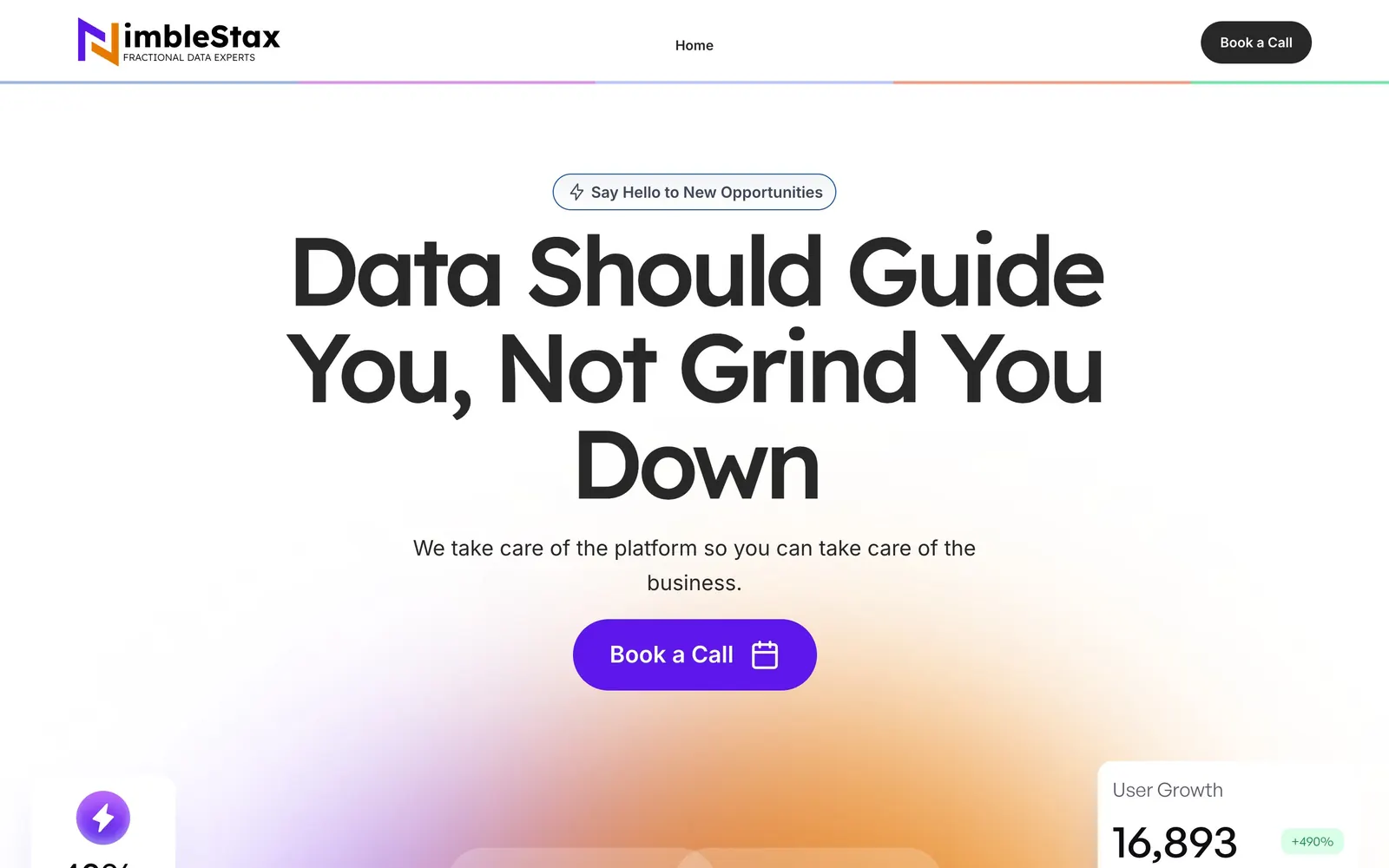
NimbleStax, data experts, is a design and build case: NimbleStax gives growing companies fractional data experts, and Pavlo Zhydkykh designed the company's website and built the site in Framer, with a blog on the Framer CMS. The site went live in August 2026 and lists 9 pages in the sitemap.
Livenimblestax.comDoes ChatGPT recommend your website?
Free report in 48 hours · 5 AI engines
- Client
- Fractional data experts
- Market
- B2B
- Work
- Design and build
- Blog
- Framer CMS
- Pages
- 9 in the sitemap
- Live since
- Aug 2026
Key takeaways
- Pavlo Zhydkykh designed the NimbleStax website and built the design in Framer, so one person carried the project from layout to launch.
- The NimbleStax blog runs on the Framer CMS: each post is a CMS item with a page under /blog/.
- The sitemap lists 9 pages: the home page, terms and conditions, a privacy policy and the blog posts[4].
- Web design spans UI design, UX design, authoring and search engine optimization[1].
- Google defines people-first content as content created primarily for people, not to manipulate search engine rankings[2].
What is web design?
Web design is the work of planning how a website looks and reads: page structure, layout, type, images and the path to one action. For NimbleStax, Pavlo Zhydkykh designed the site and then built the design in Framer himself, so the design and the build sat with one person.

“I like projects where I design and build. Nothing gets lost between a Figma file and the live page when one person does both.”
Scope
What Pavlo did
- 01
Website design
- 02
Build in Framer
- 03
Framer CMS blog
- 04
Legal pages
Full page
The home page,
top to bottom
The whole NimbleStax home page as it is live today, scaled down. Pick a section or scroll inside the frame.

Checklist
6 checks for a Framer CMS blog before launch
What Pavlo checks on a blog like the NimbleStax one before the site goes live. The same list works for any blog on the Framer CMS.
1. One collection with clear fields
Title, slug, date, cover image, summary and body as separate CMS fields, so every post follows the same layout.
2. Readable slugs
The slug comes from the post title, as in /blog/why-you-don-t-need-a-bloated-data-stack-to-grow on NimbleStax, not from an ID.
3. A title and description per post
The SEO title and meta description are bound to CMS fields, so each new post gets a search snippet without extra work.
4. Posts in the sitemap
Every published post belongs in sitemap.xml. On NimbleStax the blog posts sit in the sitemap next to the main pages.
5. Article schema
BlogPosting JSON-LD with the headline, the date and the author tells search engines and AI assistants what each post is.
6. Legal pages linked
Terms and a privacy policy, linked from the footer of every page. NimbleStax has both in the sitemap.
Fit check
Is a design and build project
right for you?
A good fit if
- You know your offer and your buyers, but the website is not designed yet.
- You want one person on both the design and the Framer build, with no handoff between studios.
- You plan to publish articles and want a blog your team runs in the Framer CMS.
- A focused site fits your stage: a strong home page, a blog and legal pages, like the 9 pages of NimbleStax.
Not the right fit if
- Your design is already finished: then a Framer build from your design fits better, as on Sancts.
- The site must run on Webflow or WordPress: Pavlo builds only on Framer and Astro + Sanity.
- You need a logged-in product or dashboard: that is app work for your engineers, not a website build.
Compared
Design and build, or a build from your design
Pavlo works both ways. NimbleStax was designed and built by him; Sancts was built in Framer from the client's design.
| Criterion | Build from your design | Design and build |
|---|---|---|
| Who designs | Your designer, in Figma | Pavlo Zhydkykh, in Figma |
| Handoff | Design files passed to the build | None: one person from layout to launch |
| Feedback | On the working site | One round on the design, one on the working site |
| Best when | The brand and layouts are final | The offer is clear, the site is not designed yet |
| Example | Sancts, 15 pages in English and Dutch | NimbleStax, 9 pages with a CMS blog |
How it works
How a design and build
project runs
The order Pavlo follows on a site he designs and builds, the kind of project NimbleStax was. A multi-page site takes 2 to 4 weeks.
| # | Step | When | What happens | You get |
|---|---|---|---|---|
| 01 | Call and fixed price | Week 1 | A call about the offer, the buyers and the pages. | A fixed price and timeline in writing |
| 02 | Design in Figma | Weeks 1-2 | The home page and key pages designed first, so the look is agreed before the build. | A Figma design of the key pages |
| 03 | Feedback, round 1 | Week 2 | Your comments on the design, applied before the build starts. | An approved design |
| 04 | Build in Framer | Weeks 2-4 | Responsive pages, components and CMS collections such as a blog, built in Framer. | A working site on a preview link |
| 05 | Feedback, round 2 | Week 4 | A second round on the working site, on desktop and phone. | Final fixes |
| 06 | Launch | End of week 4 | Domain connected; titles, meta, schema and sitemap checked. | A live site, then $30 an hour when needed |
In their words
Design and content, in the words
of the docs and Pavlo's clients
Word for word, with the source linked: research, official documentation and the people Pavlo Zhydkykh has worked for.
“Web designers are expected to have an awareness of usability and be up to date with web accessibility guidelines.”
“People-first content means content that's created primarily for people, and not to manipulate search engine rankings.”
“The design should speak the users' language.”
“He is amazing in what he contributes, both design-wise and also from the ideas.”
“One of the best contractors I have worked with. Really thoughtful about communication. Would 100% hire again.”
“It was an absolute pleasure working with Pavlo. The quality of work he delivered was AMAZING.”
FAQ
Questions about
the NimbleStax project
Still unsure? Ask your AI about Pavlo Zhydkykh:
Q.01What did Pavlo Zhydkykh do for NimbleStax?
Pavlo designed the NimbleStax website and built the site in Framer, with a blog on the Framer CMS and the legal pages. The site went live in August 2026.
Q.02How does the NimbleStax team publish blog posts?
Each post is an item in the Framer CMS, and Framer gives every item a page under /blog/. A new post needs no developer and no new layout.
Q.03How much does a design and build project cost?
A landing page starts at $1,200 and a multi-page website at $3,000, fixed in writing before work starts, with two feedback rounds included. The NimbleStax budget is not published.
Q.04How long does a site like NimbleStax take?
A multi-page site takes 2 to 4 weeks from the first call to launch, and a single landing page 1 to 2 weeks.
Q.05Is SEO included in a design and build project?
Yes. Titles, meta, schema, sitemap, redirects and llms.txt are part of every build Pavlo does, at no extra cost.
Q.06Who owns the website after launch?
The client does: the Framer project sits in the client's workspace and the domain stays in the client's name. Later changes by Pavlo cost $30 an hour, with no retainer.
About the author
Pavlo Zhydkykh
Pavlo Zhydkykh is a web designer and developer in Eastern Europe who has built websites for AI, fintech and B2B startups since 2016, designing and building each project himself on Framer or Astro + Sanity. Clients include MStudio Asia, Silicon Data, Inturai, Accolade Pro, NimbleStax and Sancts.
- Top Rated on Upwork
- 100% Job Success
- 10 years since 2016
- 50+ sites shipped
- 90+ PageSpeed at launch
About Pavlo LinkedInUpworkContra Privacy policy
Page reviewed by Pavlo Zhydkykh · Updated
Numbers
Numbers you
can check
Read from the live site, its sitemap and the Wayback Machine on 21 October 2026. Each one links to its source.
- Pages in the sitemap
- 9 Open the sitemap
- First capture on Framer
- Aug 2026 Open the archive