Custom code vs no-code for your SaaS website - an honest 2026 comparison of cost, speed, SEO and flexibility, plus the decision framework I use with founders.
Written by

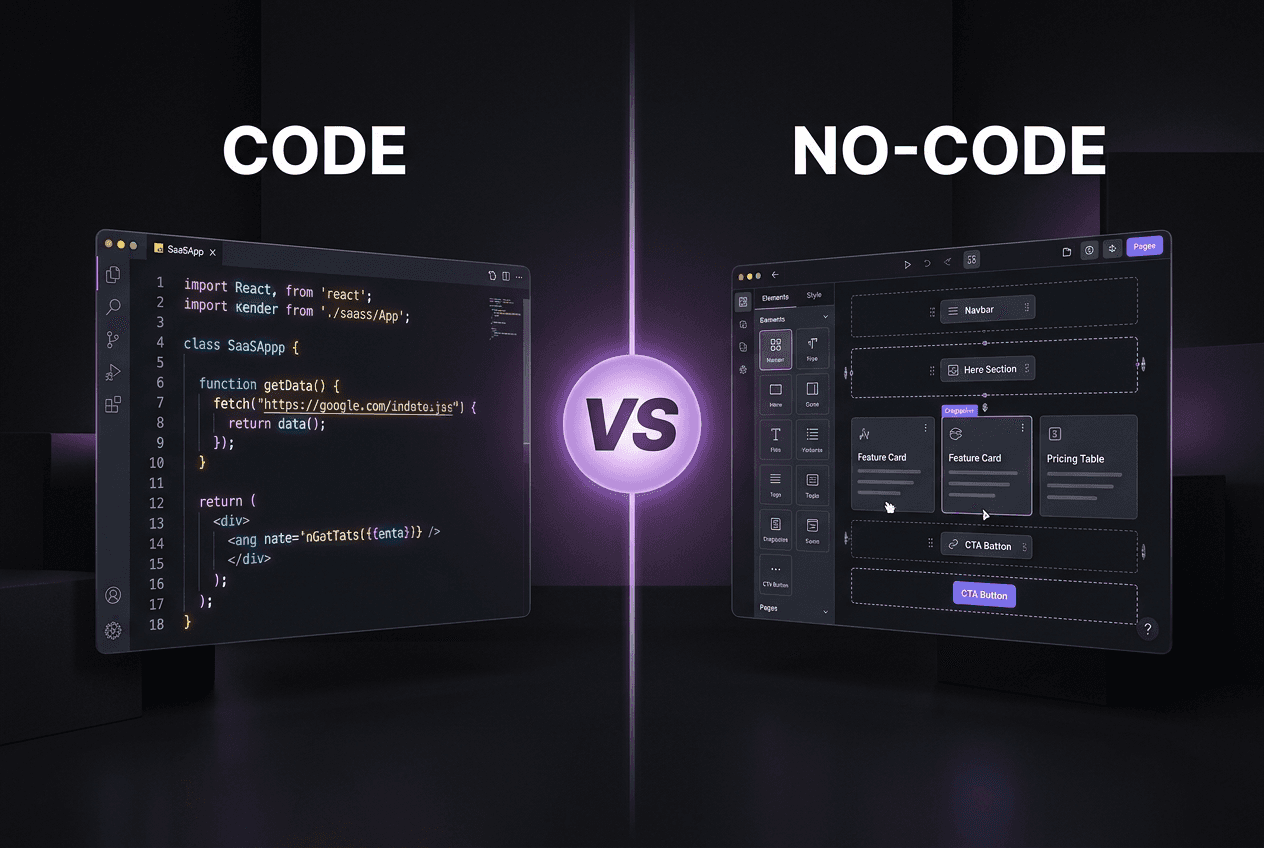
Should your SaaS site be custom-coded or built on a no-code platform? After years of building marketing sites for SaaS products - and rescuing a few that chose wrong - I can tell you the custom code vs no-code decision is rarely about technology. It is about who needs to change the site, how often, and what happens when engineering is busy. Here is the honest comparison, and the framework I walk founders through.
Key takeaways
Your product and your marketing site are separate builds with separate jobs - make the custom code vs no-code call for each one, not once for both.
A no-code platform now covers roughly 90% of what a SaaS marketing site needs: CMS, SEO control, animation and fast hosting out of the box.
Custom code earns its price when the site needs deep product integration, complex logic or genuinely novel interactions - not for a standard marketing site.
The biggest hidden difference is iteration speed: who can change the pricing page at 5 p.m. on launch day without filing a ticket.
Most modern SaaS teams land on a hybrid - a no-code site with small custom code components exactly where they pay off.
Custom code vs no-code: what you are actually choosing
The custom code vs no-code debate sounds technical, but for a SaaS company it is an operations decision wearing a technical costume. Start by splitting the question in two. Your product - the app people log into - will be custom-coded; that was never in doubt. The open question is the marketing site: the homepage, pricing, features and blog that do your selling. Those two builds have different jobs, different owners and wildly different change frequency, and they do not need the same answer.
You are not choosing a technology. You are choosing who is allowed to change your website, and how fast.
On real projects the deciding factor is almost never rendering speed or framework taste. It is the Tuesday afternoon when marketing wants to test a new headline and engineering is mid-sprint. If every site change costs a ticket, your website ships at the speed of your backlog - and in practice that means it quietly stops shipping at all.
Custom code vs no-code at a glance
The upfront numbers deserve context - where they land inside that range depends on scope, pages and who builds it, and I break the routes down properly in how much a SaaS website costs to build. The row that founders underestimate is iteration speed. A site that costs half as much but cannot be changed without an engineer is not cheap; it is a slow leak priced as a saving.
When no-code is the right call
For the marketing site of most SaaS companies, no-code now wins on every axis that matters commercially:
You launch in weeks, not quarters. A focused build ships in one to four weeks, which matters when the runway is measured in months.
Marketing owns the site. New headlines, pricing experiments, campaign landing pages and blog posts happen without a ticket queue.
Performance is handled for you. Modern no-code output is fast by default - on Framer I routinely hit the scores I describe in my guide to 90+ Core Web Vitals without touching a bundler.
The patterns that convert are buildable. Every one of the ten SaaS website design patterns I reuse on client projects works in no-code, from proof strips to pricing UX.
The total cost is knowable. A subscription and an occasional freelancer, instead of a permanent dependency on your most expensive people.
As a concrete example of how far the approach stretches, my free Verius template (https://framer.link/cYrXnHM) is a complete SaaS marketing site - product story, feature sections, pricing and FAQ - that a founder can remix and have live under their own brand in a weekend.
When custom code earns its price
There are cases where I tell founders to code the site, and they share a theme: the website has stopped being a brochure and started being part of the product.
The clearest signals: the site must render live product data - think usage-based pricing calculated from your actual billing engine; visitors get a logged-in, personalised experience before they ever reach the app; the centrepiece is an interactive demo or sandbox driven by your real backend; or compliance forces you to self-host every byte you serve. A dedicated web engineering team changes the maths too - if the site has full-time engineers, custom code stops carrying its usual coordination tax.
Notice what is not on the list: animations, a blog, SEO, dark mode, localisation or “we want it to feel premium”. All of those are solved problems on a good no-code platform, and paying custom-code prices for them is the most common overspend I see in SaaS website budgets.
A ten-minute decision framework
Run the decision like this, in order:
Split the builds. Product is code; the marketing site is the open question. Never let one answer decide both.
Count your monthly site changes. Look at the last quarter: headlines, pages, experiments, posts. More than a handful per month strongly favours no-code.
List the genuinely custom elements. Write down everything you believe needs code, then check how many are covered by embeds, integrations or code components. The list usually shrinks to zero or one.
Price both routes over 24 months. Include every engineering hour at its real cost - recruitment, salary, opportunity cost - not just the build quote.
Name the owner. If the day-to-day owner of the site is marketing, no-code. If it is a dedicated web engineering squad, custom code becomes defensible.
If the wider terminology is fuzzy - no-code, low-code, where the boundaries sit - IBM’s short explainer is a solid five-minute primer: https://www.youtube.com/watch?v=L9P9qxzKJKA (No-Code vs Low-Code, IBM Technology).
The hybrid route most SaaS teams actually take
The quiet truth of 2026 is that the either/or framing is out of date. The stack I build most often is a no-code base with custom code injected precisely where it pays: a React code component for an interactive pricing calculator, an API-driven proof widget showing live signup numbers, a WebGL flourish in the hero of a product launch page. Marketing keeps the keys to the site; engineers contribute components instead of owning pages; nobody files a ticket to fix a typo.
That hybrid also future-proofs the decision. If one section of the site eventually needs to become real product surface, you rebuild that section in code - not the whole site. The structure I use for those builds follows the same section logic as the SaaS landing page structure that converts, with the custom pieces slotted in where the argument needs them.
Want a SaaS site that ships fast and still feels custom?
Pavlo Zhydkykh builds conversion-first SaaS marketing sites on Framer - including the custom code components where they genuinely pay off. If you are weighing up custom code against no-code for a rebuild or a launch, get in touch and he will tell you which route fits your team, honestly.
Related reading
Is a no-code website good enough for a SaaS company?
For the marketing site, yes in the vast majority of cases. Modern no-code platforms handle CMS, SEO, animation and performance to a standard that satisfies most engineering teams. The product itself is a different build with a different answer — the mistake is letting one decision cover both.
How much does a custom-coded SaaS site cost compared to no-code?
A custom marketing site typically runs $15,000–$60,000+ upfront, against $0–$8,000 for a template or freelance no-code build. The bigger long-term gap is maintenance: custom sites consume engineering hours for every change, while no-code runs on a hosting subscription of roughly $20–$75 per month plus occasional freelance help.
Does custom code give better SEO than no-code platforms?
Not inherently. Good no-code platforms output clean markup, fast pages and full control over metadata, redirects and structured data — the things rankings actually respond to. A well-maintained custom build can match that, but a neglected one usually performs worse, because SEO fixes end up queued behind product work.
Can I combine custom code with a no-code platform?
Yes, and it is increasingly the default. Platforms like Framer accept custom React components, scripts and API integrations inside a no-code site, so calculators, live data widgets and WebGL moments coexist with pages marketing can edit. You get engineering flexibility only where the site needs it.
When should a SaaS company move off no-code entirely?
When the marketing site needs your product's live data at render time, personalises for logged-in visitors, or has a dedicated web engineering team behind it. Even then, migrate the section that needs code rather than the whole site — the blog and standard pages rarely benefit from the move.


